Looking Back: 1st Future Fiction Makerspace


At this three-day event, jointly organized by the Department of English II and the Department of German Language and Literature II, students, teacher trainees, in-service teachers, and researchers from across the EU explored cultural practices of future-making – including literature, theatre, poetry, and museum exhibitions – that can be integrated into literary and language learning classrooms.
Keynote Inspirations
After welcome addresses by Nsah Mala (coordinator of UNESCO/MOST BRIDGES Hub Cologne for Planetary Wellbeing and Ecological Flourishing), Beatrix Busse (Vice rector and Chief Development Officer of teff), and the event’s hosts and Cologne teff representatives Roman Bartosch and Wiebke Dannecker, the Future Fiction Makerspace kicked off with an engaging talk by the renowned playwright Chantal Bilodeau. Her insightful remarks about the role of storytelling in shaping the future set the tone for the following collaborative effort to discuss, develop, and test literary future-making strategies in the context of transformative education.
The keynote inspirations by Carmen Sippl (UNESCO Chair in Learning and Teaching Futures Literacy in the Anthropocene, PH Niederösterreich) Per Esben Svelstad (NTNU Norway), and Julia Hoydis (University of Graz) on the second day of the event picked up on the significance of aesthetic, performative, and creative practices for envisioning planetary futures. Their input prepared participants for the task to co-create narratives for future-making in the workshops on the third day of the event.
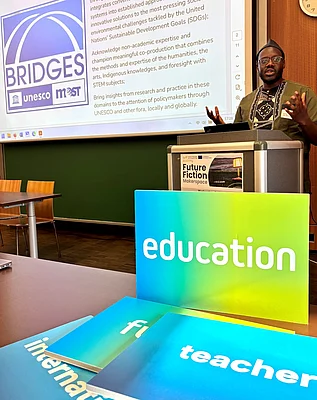
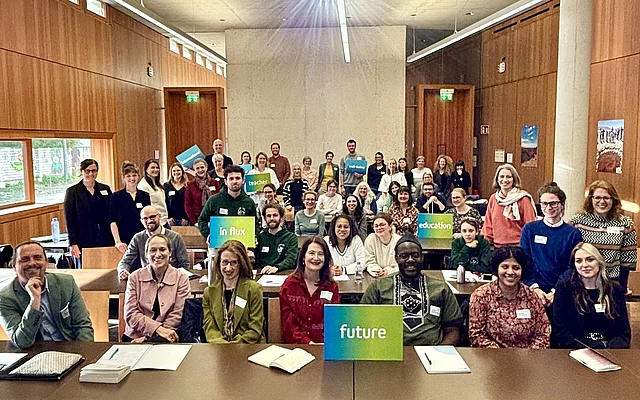
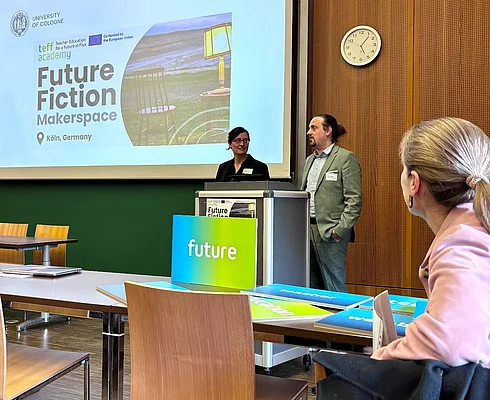
Hands-On Workshops in Future Fiction Laboratories
On the last day of the event, participants learnt more about creative approaches to thinking about the future in in more detail in different laboratories lead by international experts and early-career researchers. These included a Climate Fiction Lab, a Theatre Lab, a Poetry Lab, a Futures Stories Lab, an Adaptation Lab, and an Exhibition Lab. Each laboratory dealt with either literary, theatrical, lyrical, or curatorial teaching approaches, which could be used by participants to co-create learning environments in which futures literacy may be cultivated.
Participants in the Climate Fiction Lab had the opportunity to test, assess, and advance the prototype of a tool developed to help teachers make informed decisions about which works of climate fiction to read in their literary and language learning classrooms. In the Theatre Lab, participants engaged with performative approaches as futuring practices and the experience of embodied agency. Participants in the Poetry Lab were introduced to techniques of creative writing and storytelling and together learned to give voice to their as well as more-than-human voices for the future. The Futures Stories Lab outlined how children's and young adult fiction can be harnessed to advance futures literacy in young readers, and the Adaptation Lab continued this exploration with creative and multimodal task designs. Finally, the Exhibition Lab used curatorial theory and practice to enhance futures literacy in a jointly planned exhibition concept.
Workshop results were presented and discussed at the end - which also marked the beginning of ongoing collaboration. The co-designed results were an impressive demonstration of the creative potential of transdisciplinary and cross-institutional collaboration - and everyone agreed that we should continue our exchange and explorations.
The Future Fiction Makerspace combined theoretical input with hands-on teaching strategies and activities. Participants left with practical tools they can try out and further develop at their individual educational contexts.
We are looking forward to the follow-up event on 30th October 2025, which will be held online - please find all relevant information, as well as registration, here: [link coming soon]
